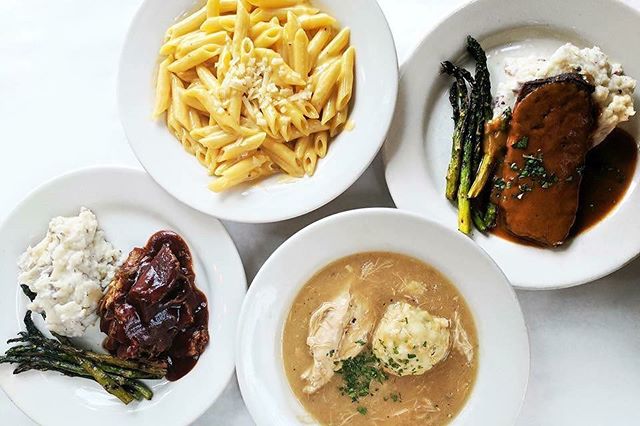

This dish is almost as popular as our pot roast, probably because so many people grew up eating their mother’s or grandmother’s version. Traditionally, chicken and dumplings is like a thick, creamy chicken soup with a layer of doughy dumplings that steam right on top while the soup simmers. Some make the dumplings “slippery,” with flour and water for a denser, chewier texture. But ours are layered with butter and leavened with baking powder, making them more like biscuits.
Back in the day, a lot of moms turned to biscuit mix to save time, so not many people remember dumplings as tender and delicious as these. Making the biscuits from scratch takes just a few minutes more than a mix, and the results are far superior.
convertIngredients For Belle’s chicken soup broth 2 whole chickens, plus other carcasses if available 2 yellow onions 4 ribs celery (cut in half to fit the pot, if necessary) 4 carrots, peeled (cut in half to fit the pot, if necessary) 4 parsnips, peeled (cut in half to fit the pot, if necessary) 1 bunch fresh Italian (flat-leaf) parsley, with stems (about 20 sprigs) 4 1/2 teaspoons kosher salt (divided) 2 teaspoons freshly ground black pepper (divided)
For the chicken gravy 8 tablespoons unsalted butter, cut into pieces 1 cup all-purpose flour 7 cups chicken broth from Belle’s Chicken Soup 2 teaspoons kosher salt 1/2 teaspoon freshly ground black pepper 2 large carrots, peeled and diced (1 1/2 cups) 5 ribs celery, diced (2 1/2 cups)
For the dumplings 2 cups all-purpose flour 1 1/2 teaspoons baking powder 1 scant teaspoon kosher salt 1 tablespoon finely chopped fresh Italian (flat-leaf) parsley 3 tablespoons cold unsalted butter, cut into 1/2-inch pieces 2/3 cup whole milk
For serving 5 cups cooked chicken (you can use the cooked chicken from making Belle’s broth; remove the skin and pick the meat off the bones, keeping the meat in large chunks; or cook a 3-pound chicken) 2 tablespoons finely chopped fresh Italian (flat-leaf) parsley, for garnish
Method Make the chicken soup broth 1. In a narrow, deep pot just large enough to hold the chickens (10- to 12-quart capacity), place the chickens, onions, celery, carrots, parsnips, and parsley. (Make sure you use a narrow pot rather than a wide one. Otherwise, you may have to use too much water to cover the chickens.) Add just enough cold water to barely cover the chickens (ideally, not more than 5 quarts, or 20 cups). Bring to a boil over high heat, skimming off any scum that rises to the surface. Reduce the heat to a simmer (rapidly boiling soup or stock often makes it look cloudy instead of clear) and season with 2 teaspoons of salt and 1 teaspoon of pepper. (You’re seasoning here because you want the chicken to have some flavor when you use it later in other dishes. The soup will be seasoned again later.)
2. Simmer the broth, uncovered, for at least 3 hours. Season again with 2 1/2 teaspoons salt and 1 teaspoon pepper. Taste; if it tastes like chicken, it’s ready. If not, let it cook a bit longer and taste again. It can cook for another hour as long as it is barely simmering, but no more than 4 hours total or the chicken will dry out.
3. When the broth is done, turn off the heat, lift the chicken from the pot with slotted spoons or a spider and set aside in a large bowl or on a rimmed baking sheet until cool enough to handle.
4. Strain the broth into a clean 6- to 8-quart pot, and discard the solids. If you’re not making the soup right away, cool and refrigerate the broth so you can scrape off the solidified fat from the surface before. Otherwise, allow the stock to sit undisturbed for at least 10 minutes, and spoon off the fat that rises to the surface.
Make the chicken gravy 1. In a large (8- to 10-quart), heavy-bottomed soup pot or Dutch oven, melt the butter over medium heat. Add the flour and mix well to make a roux. Cook, stirring frequently, until the mixture is pale yellow and resembles fine, wet sand, about 3 minutes.
2. Whisk the broth into the roux a little at a time, allowing the roux to absorb the liquid before adding more (this will help prevent lumps). Add the salt, pepper, carrots, and celery. Bring the mixture to a boil over high heat, stirring occasionally, and then lower the heat and gently simmer for 15 to 20 minutes. Keep stirring occasionally and skim off any scum (Love Note 2) that rises to the surface.
Make the dumplings 1. Whisk the flour, baking powder, salt, and parsley together in a large bowl, and then cut in the butter using a pastry blender, two knives, or a whisk until it’s in small pieces. (Alternatively, you can use a food processor: Place the flour, baking powder, and salt in the bowl of a food processor. Pulse several times to combine. Add the parsley and pulse once or twice to incorporate. Add the butter and pulse until it is in small pieces.)
2. Add the milk and stir or pulse once or twice to moisten the flour mixture. (Do not overmix or you will develop the gluten in the flour and the dumplings will be chewy.) Gather the dough into a ball.
3. Using a large spoon or your hands, scoop out 1/4-cup chunks of dough, lightly roll them between your palms to round them out, and then drop into the simmering gravy (it’s OK if they sink), spacing them apart. Cover the pot and simmer until the dumplings are done (a knife inserted in the center should come out clean), about 20 minutes. (Avoid lifting the lid while the dumplings are cooking because it slows down the cooking process, and “if you’re lookin’ you’re not cookin’!”)
To serve 1. Gently stir the cooked chicken into the pot with the dumplings, return the liquid to a simmer, cover, and cook for 5 more minutes to heat the chicken through. Using a serving spoon or tongs, divide the chicken and dumplings among soup bowls. Ladle the gravy over the chicken and dumplings, sprinkle with the parsley, and serve.
Love Notes 1. This chicken and dumplings recipe is delicious with the broth from Belle’s Chicken Soup. (You need just the broth, with no other ingredients or additions). In a pinch you can use canned low-sodium chicken broth and a rotisserie chicken and still have a good meal. When you add the chicken, feel free to stir in any leftover vegetables you have lurking in the fridge, such as steamed broccoli or green beans or braised greens.
2. When simmering gravies or sauces that include flour, be sure you skim off any scum that rises to the surface with a large serving spoon or ladle. This scum contains proteins and fibers from the flour that can make a sauce gummy.
Poached Pear, Rogue River Blue Cheese, and Hazelnut Salad
I love the interplay between sweet and savory that fruit can add to salads. Here, fresh pears are poached in red wine to give them a gorgeous color and deeper flavor that’s delicious with the assertive blue cheese and toasty hazelnuts. This is definitely a company-worthy dish, although if you make the components ahead you can enjoy it even on a busy weeknight. Store any leftover vinaigrette in an airtight container in the fridge and use a couple of weeks.
Editor’s note:You’ll make four poached pears by following this recipe but only two are required for four salads. You can easily convert the extra pears to an impromptu dessert with a dollop of mascarpone cheese whipped with a bit of heavy cream and powdered sugar. Toss on a few candied nuts for a finishing touch.—Linda Avery
convertIngredients For the poached pears 1 1/2 cups inexpensive dry red wine 1 1/2 cups water One 2-inch strip of lemon zest, removed with a vegetable peeler 2 tablespoons lemon juice (about 1 lemon) 1 cup granulated sugar 4 whole cloves 1 cinnamon stick 4 firm, ripe Bartlett or d’Anjou pears, peeled with stems intact
For the salad 1/4 cup red-wine vinegar 1 teaspoon Dijon mustard 1/3 cup hazelnut oil 1/3 cup canola oil (or 2/3 cup if not using hazelnut oil) 1/2 teaspoon kosher salt 1/4 teaspoon freshly ground black pepper 6 cups mesclun greens, washed and dried 2 Red Wine–Poached Pears 2 1/2 ounces Rogue Creamery® Oregon Blue or other blue cheese, crumbled (about 1 cup) 1/2 cup hazelnuts, lightly toasted, skins removed, and chopped
Method Make the poached pears 1. Combine the red wine, water, lemon zest, lemon juice, sugar, cloves, and cinnamon stick in a narrow, deep saucepan that holds at least 3 quarts. Set the pot over medium-high heat and bring to a boil, whisking occasionally to dissolve the sugar. Reduce the heat and simmer for about 5 minutes.
2. Stand the pears up in the liquid or lay them down so they are covered by the poaching liquid. Place a small heatproof plate on top to keep them submerged.
3. Cover the pot and gently simmer the pears over low heat, turning them occasionally with tongs, until fork-tender, 10 to 15 minutes.
4. Remove the pot from the heat and allow the pears to cool in the liquid. Remove the spices and lemon zest. Refrigerate the pears in the poaching liquid for up to 3 days. Ideally, let the pears come to room temperature before serving.
Make the salad 1. In a small bowl, whisk together the vinegar and mustard. Add the oils in a slow, steady stream while whisking vigorously. Continue whisking until all of the oil is incorporated and the dressing is thickened. Add the salt and pepper.
2. In a large bowl, toss the mesclun with 2 1/2 tablespoons of the dressing and taste. Add more dressing, if needed. Divide the greens among four plates.
3. Halve and core the poached pears. Cut lengthwise into 1?4-inch slices and evenly distribute on the greens. They also look nice sliced but held together by the upper part of the pear (called “fanning”). Sprinkle with cheese and hazelnuts, drizzle with reduced syrup if desired and serve.
Love Notes 1. Nut oils are a wonderful way to add depth to salads and tie the dressing into the rest of the ingredients. Hazelnut oil is available in the gourmet section of most grocery stores and through online gourmet retailers.
Nut oils go rancid rather quickly, so buy them in small quantities and store in the refrigerator. The oil will solidify when chilled, so set the bottle out 10 minutes before using so it has a chance to liquefy again. Sniff your oil before using to ensure it hasn’t gone bad. If it smells soapy or acrid, or like linseed oil, throw it out.
2. To toast or roast hazelnuts, heat the oven to 275°F (135°C). Spread the shelled hazelnuts in a single layer on a baking sheet. Toast for 20 to 30 minutes, or until the skins crack and the nuts turn light golden brown and smell fragrant. You can also roast them at 350°F (175°C) for 10 to 15 minutes, but check them periodically to be sure they don’t burn. Remove the nuts from oven and set aside to cool.
3. Toasting hazelnuts loosens their skins considerably. To remove the skins from toasted hazelnuts, place them in a colander with large holes. Put the colander in the sink and use a clean dishtowel to rub the nuts so the skins peel off. Shake the colander occasionally to encourage the skins to fall into the sink.
Another way to remove the skins is to put the warm nuts onto a clean dishtowel and gather it closed. Let the nuts steam for 4 to 5 minutes, then rub vigorously for 1 to 3 minutes. Rub longer to remove even more skin.
For recipes, like a cake, that require all the skins to be removed, blanch the nuts for 1 minute in boiling water spiked with baking soda (1 tablespoon per cup of water). Then plunge the nuts into cold water; the skins will slip right off. In this case, you would roast them after they were peeled, at the lower temperature.
Uber-chef Thomas Keller takes on American comfort food, with 350 pages of lush photos and laborious recipes for classics like fried chicken and split pea soup - and trust us, Paula Deen it’s not.
Moosewood Restaurant dishes out another vegetarian cookbook, this time with less cheese, more whole grains, even more vegetables - and some very tasty recipes - in its charming no-frills design.
And the Lee Brothers give us another gem: quick and easy Southern dishes updated from the long-simmered and the deep-fried, presented along with charming food memories from the South.
Clearly, the economy hasn’t slowed the publishing industry from churning out cookbooks this season, from the lavish to the practical.
But a few themes dominate: comfort, home-style, and healthy, with a hearty helping of you-can-do-this encouragement, perhaps for those forgoing take-out to save money, and those putting pan to stove for the first time.
Some of these books are beautiful, some are flawed, but, most important, some contain truly great recipes.
Moosewood Restaurant Cooking for Health, The Moosewood Collective, Simon & Schuster Paperbacks, $24.99.
It has long seemed that the crunchy-granola fare from the Moosewood gang was more about being earnest than being actually tasty. But a couple of things can’t be disputed: When the Moosewood Restaurant in Ithaca, N.Y., opened in the ’70s, it was ahead of its time in championing ethnic grain-based dishes. Second, it seems to have finally noticed that flavor counts - even in cheap, hippie-dippy, vegetarian cookery. We were pleasantly startled at the transformation of a plain-jane sweet-potato and vegetable stew called Spanish Stew once we added the recommended romesco sauce, a mildly spicy, nutty Catalan sauce that doubles nicely as a dip. And we were just as happy with the simple Mexican scrambled-egg breakfast dish, called migas, that perfumed our kitchen with the crushed corn tortilla chips you add to the batter. You won’t find any sexy food photos in the book. But you will find impressively clear typography and instructions geared to real, everyday cooks in everyday kitchens.
- Rick Nichols
My New Orleans: The Cookbook, by John Besh, Andrews McMeel, $45.
For most Americans, the food of New Orleans has been indelibly defined by larger-than-life celebrity chefs, from the blackening craze of Paul Prudhomme to the spice-tossing Bam!-tics of Emeril Lagasse. We would be lucky if the more nuanced John Besh becomes the heir-apparent.
Besh is a bayou-bred former Marine steeped in local culture, who learned to cook in Europe and now owns some of the city’s finest eateries. Few are as qualified to illuminate the passion for local ingredients, tradition, and sophistication that defines the post-Katrina generation of chefs. And he makes a compelling case for the city’s culinary relevance with 200 recipes that give the full sweep of today’s New Orleans table, from stellar renditions of classic redfish court bouillon and gumbos galore, to the immigrant influence with his Vietnamese shrimp Creole. It’s as richly colored as the subject at hand and a welcome introduction to New Orleans’ most appealing culinary ambassador in years.
- Craig LaBan
Good Eats: The Early Years, by Alton Brown, Stewart, Tabori & Chang, $37.50.
OK, I’m unlikely to ever actually buy a book stamped with a logo “As Seen on Food Network.” But that doesn’t mean I won’t seriously browse through one if it lands on my desk. To wit: I’ve been browsing Good Eats, which is like watching the TV series with the mute button on; not a bad thing in my book. The fact is, Alton Brown can be comic, and he has tasty side notes - don’t drain your noodles all the way or they’ll stick; anchovies weren’t in the original Caesar salad; a long nylon spatula from Matfer is great for flipping trout. But his campy shtick can be wearying unless you’re still in college or just getting out. Enter the pause button (also known as the print version). This book covers his first 80 episodes, and if you have an Alton Brown addict on your holiday list, well, why not give ‘em what they like? The recipes are elementary and classic. The layout is jump-cutty and personality-driven (lots of candids of Alton). And there are instructions for a 10-minute microwave applesauce with honey and cognac that I’ve decided to give a try.
- R.N.
Ad Hoc at Home, by Thomas Keller, Artisan, $50.
It’s comforting to know that even culinary gods like Thomas Keller, the chef behind the gastronomic temples French Laundry and Per Se, love to make good fried chicken, beef stroganoff, or strawberry shortcake. But do we all need to approach our comfort food with the rigors of a four-star chef? I’m not so sure after tackling Keller’s latest book. Based on recipes from his casual Napa restaurant Ad Hoc, this gorgeous tome makes a strong photogenic appeal for upgrading American standards. But even the “uncomplicated Keller” is bound to challenge most amateurs with daylong simmer-and-strain projects, Vita Prep blending, ice baths, and, yes, the inevitable plumber’s torch. There are plenty of nice little cooking tips (snuggling short ribs in cheesecloth to keep them tidy), and yes, Ad Hoc’s fried chicken is fantastically juicy (albeit a tad sweet). But when it comes to spreading the gospel of home cooking for most Americans, Paula Deen has little to worry about.
- C.L.
Mother’s Best, by Lisa Schroeder, Taunton Press, $28.
This new comfort-food cookbook, a collection of recipes from Lisa Schroeder’s popular Portland, Ore., establishment Mother’s Bistro and Bar, is written “in the voice of a mother teaching her adult child to cook,” she says.
It’s filled with tempting recipes, insightful tips, and bits of Mother’s wisdom, or “Love Notes.” Unlike many books that assume you know how to cook, Mother explains technique thoughtfully, explaining both why and how.
It’s worth buying this book for the incredible pancake recipes alone. The Almond Poppyseed Pancakes were so good my husband wants them to replace the French toast I have made for a decade of Christmases.
An entire chapter is devoted to macaroni and cheese, with nine recipes and variations: bacon and cheddar, one with spinach and ricotta, and a Southwestern version, too.
It wouldn’t be a “Mother’s” cookbook without cookies. The Triple Chocolate Chubbies are the ones we all want in the cookie jar: a cookie-fudge-brownie studded with nuts and chocolate chips. All you need is a glass of milk.
- Robin Currie
Momofuku Cookbook, by David Chang, Potter, $40.
The rise of wunderkind David Chang, from kitchen grunt to “it” chef of New York, is an improbable tale worth the price of his Momofuku Cookbook. But learning how this Korean American from Virginia turned a trio of restaurants named after the inventor of instant ramen soup into an East Village sensation is only half the fun. Chang cooks with the in-your-face abandon of a man obsessed (pork, kimchi, noodles, and more pork) and there’s a wealth of stellar recipes here that are destined to become fixtures in my family. Not necessarily all the hipster chef moves - though there are plenty of those, including “ghetto sous-vide.” No, Chang proves his genius to home cooks by working magic of the most minimalist order, like the 10-pound pork butt that’s transformed with only sugar and salt (and six hours in the oven) into a bo ssäm masterpiece, or brilliant condiments like the ginger scallion sauce or “octo vinaigrette,” or the puffy steamed Chinese buns. The range of Chang’s eclectic palate, from Southern country ham to sweet corn with miso butter, may be at times startling, but his ability to bring them together is exactly what makes him one of our most compelling chefs.
- C.L.
New American Table, by Marcus Samuelsson, Wiley, $40.
Born in Ethiopia, raised in Sweden, trained in Austria and Switzerland (with a stop in Philadelphia at the late Washington Square), Marcus Samuelsson dedicates his cookbook to “the millions of immigrants who brought these wonderful foods to their new home.”
Samuelsson, of New York’s Aquavit, writes of his culinary journeys across America, discovering Creole in New Orleans, barbecue in North Carolina, Texas, and Kansas, low-country fare along the East Coast, and salmon and wine along the West. The cookbook/travelogue is sumptuously designed and great fun. The recipes, though, are not for the faint of heart. Many are complicated and time-consuming and require hard-to-find, expensive ingredients. (A search for pumpkinseed oil was ultimately successful at the Reading Terminal Market, $17 for a tiny bottle.) But the completed pear-pumpkin salad with pumpkinseed vinaigrette produced spectacular results. Fish goulash with gnocchi, a major production, resulted in a delicious stew, redolent with smoky paprika.
Whether for the ambitious cook or merely a reader who loves food lore and beautiful photography, it’s a volume worth owning.
- Elise Vider
Simple Fresh Southern: Knockout Dishes With Down-Home Flavor, by Matt Lee and Ted Lee, Potter, $35.
The Lee Brothers’ new book is true to its title: straightforward, simple recipes using fresh ingredients, with a magical Southern flair. It promises “easy, healthy dishes for every day that won’t compromise an ounce of Southern flavor.” And it’s all true.
The charming introduction tells how the delicious Shrimp and Deviled-Egg Salad Rolls came to be, a reworking of a 1960s Shrimp-Deviled Egg Casserole with a mass of deviled eggs, cheese sauce, shrimp, and canned Chinese noodles. From that overblown wonder came their Southern spin on the Maine lobster roll recipe with an amazingly light touch.
The Collard Greens With Poblano Chiles and Chorizo was a revelation to me. The only collards I had eaten before were the overcooked, grayish variety swimming in pork liquor. Well, the heavens opened and the sun shone brighter after I made the collards from this book - earthy and tender, with just a hint of spice from the poblanos and chorizo sausage. It doesn’t get much better than this.
Cathy Routen, standing in the cookbook aisle of Auntie’s Bookstore, holds some of her recommendations for cookbook gifts this holiday season. (Full-size photo)(All photos)
How to purchase books
Check with your favorite bookseller for details on buying or ordering the cookbooks featured in today’s story.
Reach Auntie’s Bookstore at (509) 838-0206. It is in downtown Spokane at 402 W. Main Ave. Holiday hours are Monday-Saturday, 9 a.m.-9 p.m., and Sunday, 10 a.m.-6 p.m.
Want a holiday gift that is sure to bring tidings of comfort and joy? A cookbook is always a welcome gift. The hardest part will be deciding which of the beautiful tomes released this year will look best under the tree. (Or, which one to put on your own Christmas list.) For help, we turned to Cathy Routen at Auntie’s Bookstore in downtown Spokane. Routen oversees the cookbooks section of the store and she loves talking about her favorites. Just ask. She gave us four recommendations, and we threw in a few more for good measure. And because ’tis the season for excess, we also chose a few recipes from the books for holiday cooking.
“Mother’s Best: Comfort Food That Takes You Home Again,” by Lisa Schroeder with Danielle Centoni
The Taunton Press, $28, 396 pages
Routen says, “My favorite is comfort food and I’m round to prove it. … It’s nice because she has some variety, but it has some good, old basics in there, too.”
The beautiful hardback book includes 150 favorite recipes from Schroeder’s restaurant in downtown Portland, Mother’s Bistro and Bar.
Schroeder changed careers at age 35, enrolling in The Culinary Institute of America in Hyde Park, NY. After finishing school and then working 90 hours a week in Manhattan restaurants raising her daughter, she decided it was time to travel and see what it was like to work in a French kitchen and eat the foods of France, Italy, Spain and Morocco.
“That’s when I realized that the soul of a country’s cuisine is not found in its restaurants, but rather in the foods cooked at home – what I call ‘Mother Food’ – meals made with love and shared by families,” Schroeder writes in the book.
A Primer on Creating Comfort Food That’s Even Cozier than Usual
“Mother’s Best: Comfort Food that Takes You Home Again; 150 Favorites from Mother’s Bistro & Bar” by Lisa Schroeder with Danielle Centoni (Taunton, $28)
“Once upon a time,” writes Chef Lisa Schroeder in her cookbook “Mother’s Best,” “mothers would spend almost an entire day cooking. They’d put something on the stove or in the oven and let it simmer slowly while they went on with their day.
“Compared with modern life, those days have more in common with fairy tales than reality. Our lives are busier than ever, and many of us don’t have the time — or the inclination — to spend all day in the kitchen. And that’s why when we do fire up the stove, we want to make something with a big payoff — in either flavor, time savings or both.”
Chef/owner Schroeder of Mother’s Bistro & Bar and Mama Mia Trattoria in Portland, Ore., probably never thought of herself as a fairy godmother, but one in a well-worn apron is just what she becomes as she rifles off the 150 special recipes in her fat cookbook.
Can you improve on comfort food? Many people think not, after all, that’s how it garners the status as “comfort food” in the first place. It’s the special dishes of your family that are soothing enough to repeatedly put the whole gang over the moon and then some. Schroeder, though, accomplishes the near impossible. One dish after another is more calming, nurturing and downright decadent than its original inspiration.
Macaroni ‘n’ Cheese is more than just the heartwarming basics. It’s doused in heavy cream, loaded with diced bacon and served with a dollop of sour cream and a sprinkle of sliced scallions. Taking comfort to new quantities, that’s just one of nine versions (featuring a helpful primer, too) that culminates in varieties like smoked salmon, cream cheese and dill macaroni ‘n’ cheese and roasted garlic, prosciutto and provolone mac ‘n’ cheese.
Pork chops are not only marinated in orange juice and garlic, but also glazed in apple juice, honey and orange zest and served with a Granny Smith and raisin spiced chutney.
Corned beef hash (which can also be morphed into a show-stopping wild salmon hash) is mixed with a Dijon mustard horseradish cream.
“Best” chocolate pudding gets its moniker due to, not only cocoa powder and finely chopped bittersweet chocolate, but also the addition of creme de cacao or chocolate liqueur.
The love apparent in Schroeder’s many “Love Notes” (ingredient and cooking tips) as well as additional essays on countless culinary techniques seems heartily genuine as the award-winning chef pontificates on everything from peeling carrots, to avoiding pre-shredded cheese, to simmering cream until it’s so thick as to be dreamy.
BACON AND CHEDDAR MACARONI ‘N’ CHEESE
1 teaspoon kosher salt, plus more for salting the pasta water
1 pound fusilli (corkscrew) or other pasta (see Note 1)
1/2 cup thinly sliced scallions (white and green parts), for garnish
Yields 4 to 6 servings.
Bring a medium (6- to 8-quart) pot of water to a boil.
Salt it generously (it should taste like the sea). Stir in the pasta and cook according to package directions. Carefully drain (but don’t rinse, or you’ll rinse away starches that will help thicken the sauce) and carefully return to the empty pot.
Meanwhile, place a large (12- to 14-inch) saute pan over high heat for several minutes. When hot, carefully add the bacon and saute until browned and crispy (lower the heat to medium-high if necessary to prevent scorching), about 5 minutes. Carefully remove the pan from the heat and, using a slotted spoon or spatula, remove the bacon from the pan and drain on paper towels.
Pour off the fat from the pan (into a metal can or heatproof cup, not down the drain or you’ll potentially clog your pipes) and return the pan to medium-high heat. Add the heavy cream and bring to a boil, scraping up any browned bits from the bottom of the pan. Lower the heat to medium and continue to simmer until the cream is reduced slightly, about 3 minutes.
Add the cheddar cheese and bacon. Stir well and cook over medium-high heat, stirring now and then, until the cheese has melted and the mixture thickens, about 3 minutes. Season with thesalt and pepper.
Stir the sauce into the cooked and drained pasta in the pot. Place over medium heat and simmer for 1 to 2 minutes to thicken the sauce and allow the pasta to absorb the flavors, stirring now and then.
Serve in individual bowls topped with a dollop of sour cream and a sprinkle of scallions.
Note 1: Schroeder names her favored products throughout the book (e.g., for pasta: “preferably De Cecco.”)
Note 2: “Avoid pre-shredded cheese,” Schroeder writes in this “Love Note.” “It may seem like a time-saver, but much of the cheese’s flavor has dissipated and the starchy coating on the outside will interfere with the sauce.”
GARLICKY CROUTONS
1 (1-pound) loaf country or French bread with crust, cut into 1-inch cubes
3/4 cup olive oil
5 large cloves garlic, finely chopped (about 2 tablespoons)
1 tablespoon finely chopped fresh Italian (flat-leaf) parsley
2 teaspoons kosher salt
Yields about 10 cups.
Heat oven to 350 F. Spread the bread cubes in a single layer on a rimmed baking sheet. Bake until dry and barely golden, 10 to 12 minutes. Remove and allow to cool slightly.
Combine olive oil, garlic and parsley in a small bowl.
Sprinkle the salt over the bread and drizzle it with the olive oil mixture. Toss well to coat and return the pan to the oven. (See Note.) Bake until golden brown, about 10 minutes. Remove from oven and cool. Store in an airtight container for up to 2 weeks, or freeze for 6 months (and defrost before using).
Note: “You must bake the croutons twice,” Schroeder writes in this “Love Note.” “The bread dries out and gets a little color from the first baking and then gets crispy and golden the second time. If tossed in the oil mixture and then baked only once, the garlic would burn before the bread got crispy and golden.”
Lisa Messinger is a first-place winner in food writing from the Association of Food Journalists and the author of seven food books, including “Mrs. Cubbison’s Best Stuffing Cookbook” and “The Sourdough Bread Bowl Cookbook.” She also writes the Creators News Service “After-Work Gourmet” column. To find out more about Lisa Messinger and read features by other Creators Syndicate writers and cartoonists, visit the Creators Syndicate website at www.creators.com.
Once again, it’s time for the best cookbooks or food related books of the year! That’s all I’m giving this year, just cookbooks. It’s the gift that keeps on giving, right? And my relatives will make some of the food for me. Or at least my mom will.
Ad Hoc at Home,
Thomas Keller
Thomas Keller gives us fried chicken! Yes, the chef famous for the complex dishes at The French Laundry and Per Se brings us “Ad Hoc at Home,” where he gives up “simple” recipes for buttermilk fried chicken, potato hash and grilled cheese. The dishes here are meant to be served family style and they’re actually very fun. Great photos too.
The Pleasures of Cooking
for One, Judith Jones
At first I thought, “Oh, great, another rationalization for being alone, another glorification of loneliness!” But no, this book is by the woman who edited Julia Child’s books. Still going strong now that she’s in her 80s, she shows how making delicious dishes for one can be easy and lovely. One great feature is making a big dish then adapting it all week, like a Boeuf Bourguignon that becomes beef and kidney pie then becomes a pasta sauce. She gives storage tips, buying tips and more.
Chocolate: A Love Story 65 Chocolate Dessert Recipes from Max Brenner’s Private Collection
From the international chocolate shop chain Max Brenner comes these easy-to-follow recipes that everyone will love. Learn to make french toast chocolate sandwiches, Control Freak chocolate spread, chocolate pot pie and cherry soup. Frozen very hot margaritas too. The design is all funky and art deco, which is fun.
Stonewall Kitchen (multiple)
From our famed specialty gourmet foods store and Jim Stott and Jonathan King come two new cookbooks co-authored by Kathy Gunst, “Winter Celebrations” and “Breakfasts.” The recipes use Stonewall Kitchen products available just about everywhere around here and include dishes like scones, homemade granola bars and plenty of brunch recipes. In “Winter Celebrations,” try mashed parsnips and brussels sprouts with nutmeg-cardamom cream. Yum.
Mother’s Best: Comfort Food that Takes You Home Again
Lisa Schroeder and Danielle Centoni put their heads together and came up with this warm and fuzzy cookbook with recipes from Lisa’s Mother’s Bistro in Portland, Oregon. Try Nana’s Chicken Fried Chicken; Meatloaf Gravy; Manhattan Clam Chowder — yes, Manhattan — Grandma Mary’s Meatball and Sunday Gravy and Mother’s Apple Crisp. All simple and hearty.
The Italian Farmer’s Table: Authentic Recipes and Local Lore from Northern Italy
More than 150 recipes from more than 30 family arms in Italy, divided into regions. Some of these recipes have never been seen outside of their region. It’s all fresh, rustic, yet elegant food. Pork stew with prunes and pine nuts, beet dumplings with poppy seed butter, goat cheese gnocchi with walnut butter sauce.
Home Brewing: Self-Sufficiency by John Parkes
A compact handbook with easy to figure out brewing instructions and guide to just the basic equipment you’ll need. What’s really great are the original recipes he provides.
Organic Shaken and Stirred: Hip Highballs, Modern Martinis, and Other Totally Green Cocktails by Paul Abercrombie
And no, “green” doesn’t mean putting dye in your beer on St. Patrick’s Day. Organic drinks made with organic ingredients and even organic liquor if you can find it. Try a “Pineapple Caipirinha with Sweet Lime Espuma” or some of the more savory elixirs like the Fresh Basil Margarita or a Cherry Tomato Daiquiri. Bizarre yet alluring!
Born Round: The Secret History of a Full-Time Eater by Frank Bruni
Until a few months ago, Frank Bruni was the restaurant critic for the New York Times. In this memoir, he relates his experiences with overeating as a kid and his weight issues both before and during his tenure as the New York Times food dude.
Ratio: The Simple Codes Behind the Craft of Everyday Cooking by Michael Ruhlman
I always seem to be able to mention a Michael Ruhlman book. He comes out with one about once a year and they are always great. This one demystifies the way ingredients work together with regard to their properties and measurements. Knowing the relationship between ingredients can indeed help make you a better cook. I always like to find out how and why things work and in this book, Ruhlman explains the essential properties that make the ratios between ingredients work — bread dough vs. biscuit dough for example and it really does help! Check out his blog, too. It’s where I got a killer chicken fried pork belly recipe.
http://blog.ruhlman.com/
Momofuko (2009) by David Chang and Peter Meehan
David Chang’s restaurants, including his “noodle” restaurant Momofuko, are fantastic and this cookbook is gorgeous, though geared toward more seasoned cooks. Ramen is there but also chicken wings rendered in duck fat, asparagus with poached eggs and miso butter and the art form of the noodle. This might be the one I’m getting everyone on my list this year. And I’m trying to get a fried chicken reservation for the holiday week.
Ten by Shiela Lukins
Lukins died in September, but she left us with this excellent book. The co-author of the Silver Palate Cookbook, Lukins gives us 32 chapters of her favorite foods with 10 recipes for each, which is pretty much all you might ever need. Some of her faves include corn, shrimp and, of course, chocolate.
“Food, Inc.” on DVD
Yes, the fantastic documentary about what we eat and all the stuff we shouldn’t is out on DVD so pick one up, but not a mass-slaughtered chicken.
For those on your gift list who love to cook - or just read about food - here are eight new cookbooks from Iowa and beyond that entertain and educate with recipes from mac ‘n cheese to ganache-glazed brownies. Dig in!
“Forget-Me-Nots” by Lorrie Holland, illustrated by Stephanie Mills (Self-published, 2006; 131 pages; $28, hardcover. Autographed copies available at Beaverdale Books)
What it is: Classic warm and fuzzy Iowana.
Who needs it: Just-marrieds, quilters and all the folks out there who say to themselves, “Gosh, I’d love to write a cookbook.”
Lorrie Holland (she of the recipes) met Stephanie Mills (she of the simple pastel drawings) at the Lodge of Ashworth in West Des Moines where Holland worked as director of marketing. One might be forgiven for expecting page after page of canned-soup casseroles, but one will also be politely corrected. To wit: Please turn to the recipe for Orange Amaretto Saganaki.
What it is: A food-centered memoir, born of popular food blog Orangette.
Who needs it: Foodies who love to read about - and look for themselves in - other foodies who are actually making money from being a foodie.
The death of Molly Winzenberg’s father sent her back to Paris to re-create memories from a father-daughter trip. There, Winzenberg threw herself into a Julia Child-esque romance with food. The recipes run the gamut from Burg’s Potato Salad, made with an obscene potato-to-mayo ratio, to an Asian pear and fennel salad
“Damn Good Food: 157 Recipes from Hell’s Kitchen” by Mitch Omer and Ann Bauer (Borealis Books, Minnesota Historical Society Press, 2009; 215 pages; $27.95, hardcover. Beaverdale Books)
What it is: Part cookbook, part autobiography, part lesson in effective cursing.
Who needs it: People who would enjoy eating something called Lasagna Van Halen Style and people who think an occasional F-bomb is totally called for.
The press release about the book calls Des Moines native Mitch Omer “the manic-depressive, recovering drug addict, wild-eyed owner of two successful Hell’s Kitchen restaurants,” in Minneapolis and Duluth. Many of the user-friendly recipes begin with Omer’s…um…colorful commentary.
“The Illustrated Quick Cook: Time-Saving Tips, After-Work Recipes, Cheap Eats” by Heather Whinney, Editor-in-Chief (DK Publishing, New York, 2009; 544 pages; $35, hardcover. Barnes & Noble)
What it is: Big and thorough, with a full-color picture of every recipe.
Who needs it: For beginners and people who feel better if they know what it’s supposed to look like when it’s done.
This monster book covers nearly every cooking contingency. Need no-cook recipes? Got it. Things to make with what’s in the pantry? Check out the Store Cupboard chapter. The front even has a redux of the quickies-but-goodies, the Recipe Chooser, which lists (photographically) the recipes that can be done in under 30 minutes.
“The Best of America’s Test Kitchen 2010″ by the editors at America’s Test Kitchen (America’s Test Kitchen, Brookline, MA, 2009; 328 pages; $35, hardcover. Barnes & Noble)
What it is: A compendium of recipes and equipment and commercial food ratings from the folks who bring you Cook’s Illustrated magazine and the “America’s Test Kitchen” and “Cook’s Country” cooking shows.
Who needs it: Cooks who like to know the what, where, why and how of whatever they’re making.
The M.O. of America’s Test Kitchen is (go figure) to test and test again and test some more, so cooks can be confident of these recipes. Directions are very clear and detailed. The book includes ATK ratings for things like boxed brownie mixes and can openers.
“Mother’s Best: Comfort Food That Takes You Home Again”
by Lisa Schroeder and Danielle Centoni (The Taunton Press, Newtown, CT, 2009; 394 pages; $28, hardcover. Beaverdale Books)
What it is: Mother’s food, only better - and not as precious.
Who needs it: It’s aimed at inexperienced cooks but seasoned cooks will enjoy it, too. (And anyone who loves mac ‘n cheese - there are 10 recipes for it.)
The concept for Lisa Schroeder’s popular Portland, Ore., restaurant, Mother’s Bistro, came to her in an epiphany as she was wracking her brain for family dinner ideas. The book’s stated raison d’être is “preserving home cooking from mothers around the world.” Little “love notes” tucked throughout demystify ingredients.
“How to Cook Everything: 2,000 Simple Recipes for Great Food” by Mark Bittman (John Wiley & Sons, Hoboken, NJ, 2008; 1044 pages; $35, hardcover. Beaverdale Books)
What it is: As the title suggests, everything.
Who needs it: Everybody.
If you need someone to tell you how to scramble an egg, this is the book for you. It’s also the book for you if you want an everything-PLUS-the kitchen-sink reference cookbook. Icons denote fast, make-ahead, vegetarian and “essential” recipes (recipes that are “super easy and super popular”), so it’s quick work to see what you’re getting into. There are sections on food safety, equipment, techniques and a standard index is augmented by an index of recipes by category.
“Absolutely Chocolate” by the editors of Fine Cooking (The Taunton Press, Newtown, CT, 2009; 298 pages; $29.95, hardcover. Beaverdale Books)
What it is: Cookies and cakes and candies, oh my!
Who needs it: Anyone who considers chocolate a food group.
While this gorgeous book and its soon-to-be-drool-stained pages do include chocolate chip cookies, the recipes are more tarted-up tarts than tried-and-true Tollhouse. Despite that bent toward the fancy-pants, the recipes also look mostly doable and deeply interesting. How about Port Ganache-glazed Brownies with Dried Cherries for the school bake sale?
I had the honor of being a guest on “Gifts from David’s Kitchen,” a weekly show on QVC, with my new cookbook “Mother’s Best.” QVC is located in West Chester, Pa., so it gave me an opportunity to visit with my Philadelphia family over the Thanksgiving holiday. For the first time in at least 10 years I didn’t cook Thanksgiving dinner since I had to be in New York for the ”Today Show” the day before and QVC the Sunday after. Some of my regular guests at Mother’s Bistro & Bar were disappointed that we weren’t offering our traditional Thanksgiving dinner, but when I explained why, they were a little more understanding.
QVC was a hoot and David is one of the most energetic people I’ve ever met. He swears he hand-picked my cookbook for his show and couldn’t wait to try some of the dishes from it. Judging from his facial expressions, I think he liked them!
Preaching the Good Food Lisa Schroeder of Mother’s food fame hits the national scene with her new cookbook
By Amanda Waldroupe
Lisa Schroeder is just getting started.
The 51-year-old chef/owner of Mother’s Bistro and Bar and Mama Mia Trattoria is fresh off a short, East Coast tour for her first cookbook, Mother’s Best: Comfort Food That Takes You Home Again (Taunton Press, $28). While the ink still dried from its November 17 release, Schroeder talked about its recipes—and what she calls the “gospel of motherhood”—on TheToday Show and NPR’s The Chef’s Table.
Schroeder got the idea for a cookbook from her customers.
“I get asked for recipes on a daily basis,” Schroeder says. The bistro makes its recipes in large quantities, meaning that Schroeder has to rework each recipe for normal servings. “I was writing recipes anyway.”
Having penned a cookbook, she says, “gives a chef certain credibility.” Taking recipes she created or discovered from 10 years of operating Mother’s, Mother’s Best is 400 pages of what Schroeder calls “mother food”—slow-cooked, impeccably seasoned, nutritious meals any mother would cook for her children.
That is, if they had time in this age of iPhones, soccer moms, and holding down multiple jobs.
“There is a generation that lost touch with cooking at home, and were bombarded with the Jell-O, TV dinners, and Cool Whip,” Schroeder says. Her tone is frustrated and indignant, and her native New York City accent shows through. “Many of these recipes are becoming lost.”
Schroeder says her book will challenge cooks, but adds that “three things different in it from other cookbooks” should help out novices. “One is that it is written in the voice of a mother teaching her adult child how to cook,” Schroeder says. There is much hand-holding and explanation, to “eliminate the mistakes before they happen.”
Second are notes in the book’s margins, instructing cooks whether to cook a potato in cold or hot water, why one kind of cheese is preferable in a dish to another, or how big the diced onions should be. Designed to teach people how to cook, versus simply following a recipe, Schroeder calls them “love notes.”
And that third, last thing? It’s not something most cookbook owners would expect, and most cooks think unnecessary: salt-and-pepper measurements.
Justifying why she includes these calculations, Schroeder nearly goes on a tirade during her telephone interview with Just Out. She explains that cooks give measurements for every other spice and seasoning, and omitting such essential measurements leaves cooks with no “guidance and benchmark” when first learning how to make the kinds of tasty meals she treasures.
“It is a cop out,” Schroeder states.
When describing her book’s features, Schroeder also describes the philosophy of cooking that guides her life’s work: creating wholesome, delicious meals healthy for stomach and soul by putting love and care into the act.
When Schroeder had the epiphany that she wanted to cook “mother food,” she wasn’t putting that love and care into the cooking she did for her family. In 1992, she was racking her brain while still at work at a New York City catering company, thinking of where she could take her family for the good meal she didn’t have the time to make herself.
No eateries came to mind, in what prompted Schroeder to launch her crusade to create such a restaurant—and bring mother food back into the kitchen. Enrolling at New York’s Culinary Institute of America, she learned the basics of professional cooking, which she continued to refine while studying in France.
Her pursuit of mother food—and learning it to perfection—also took Schroeder to Spain, Italy, and Morocco. “These travels changed my perceptions about food forever,” she writes in her book’s introduction.
Schroeder still believes Mother’s Bistro (which opened in 2000) is the only restaurant in Portland serving mother food. That isn’t to say Portland doesn’t appreciate mother food. Nowhere else in the United States, she says, do people gather, can, and preserve the way Portlanders do.
“Smoked salmon is very motherly,” she adds.
Mother’s is also a source of entertainment for GLBT-related events, propelling Schroeder to her status as one of the gay community’s most important and high-profile allies. “I cannot sit idly by,” she says, as a large segment of the population is being denied human and civil rights she holds dear.
She ties it back to mothering and motherhood. “We are all mother’s children,” she says. And in an ideal world, “there is unconditional love that lasts no matter who one is, or what one is, or what one does.”
Schroeder makes it sound like the national sensation caused by her book won’t go to her head anytime soon. Returning to Portland on December 2, she plans to spend time “hunkering down” at Mother’s and Mama Mia, and perhaps teach some local cooking classes. “[I’ve] got a tool now,” she says.
But she also has dreams of her own television show, quickly adding that there is nothing official in the works (there are, though, pilots that can be found on her website, www.lisaschroeder.com).
“I have always wanted to have a TV show to spread the gospel of mother food,” Schroeder says. “It’s not enough to do that in a restaurant in Portland. I want to share it with as many people as possible.”
We’re thrilled Mama Mia Trattoria made it to the list for “Portland’s Top Tables for Private Dining.” We do have lots of options for different size parties, from 10 up to 60. It’s good to see we’re in good company!
Portland’s Top Tables for Private Dining
Portland, Ore. (December 2, 2009) – A robust food scene focused on value makes Portland a prime choice for private dining this season. With so many options to choose from, diners will be looking for restaurants with the right flavor for their group. Here is a list of some of Portland’s top restaurants offering unique private dining experiences.
Wildwood “Dining at The Source”
A pioneering Portland restaurant, Wildwood Restaurant & Bar epitomizes the best of Northwest dining by bringing guests straight to the source of farm fresh cooking. Chef Dustin Clark and Sommelier Jeff Moore pair their talents to create a seasonal experience in one of two private dining spaces. Both rooms accommodate up to 40 people each, and offer an elegant option for either lunch or dinner parties. Chef Clark’s personal approach to food often brings him out of the kitchen during the meal, to visit with guests and talk about what’s on the plate and where it was sourced. For more information on private dining at Wildwood Restaurant & Bar contact Shelly Jones at 503.225.0130 or visithttp://www.wildwoodrestaurant.com/.
Pazzo Ristorante “Italian Varietal”
Take a mini vacation in downtown Portland by letting Pazzo transport the holiday party to Italy with their authentic regional Italian cuisine served in three unique spaces. Tucked between the restaurant and Hotel Vintage Plaza, a glass enclosed Wine Room creates an exclusive space for an intimate party of 14 or fewer. For larger groups of up to 25 people, the family-style seating and lively atmosphere of the Pazzoria offers guests an Italian bistro dining experience. And to impress a party of up to 64 people, bring the event into the Wine Cellar where a private bar, walls of wine, and exposed brick surround a long wooden table. No matter which space is the right fit for the group, Chef John Eisenhart’s authentic cooking and Pazzo’s extensive Italian wine list will complete the evening’s adventure around the globe. For more information on private dining at Pazzo visitwww.pazzoristorante.com
Ten 01 “Chic and Functional”
In the heart of the Pearl District, Ten 01’s team of experts and the restaurant’s chic design create the ultimate celebratory experience, seamlessly blending cocktail party with fine dining. Whether taking over the Mezzanine level (which has its own bar) for parties of 30 – 90, renting out the entire restaurant, or tucking away in the private dining room that seats up to 30 (equipped with plasma screen and laptop hook ups), Ten 01 delivers an impressive and memorable evening. For very large events of 90+ guests, Ten 01 will close its doors to the public and provide you with the ultimate private dining experience – the entire restaurant. For more information on private dining at Ten 01, visitwww.ten-01.com.
Mama Mia Trattoria “Family Table”
Looking for a venue to give your next big night out some east coast familial flare? Mama Mia Trattoria, conveniently located in the heart of downtown, fits the bill. The restaurant serves delicious Italian–American soul food, like that offered at many restaurants in the “Little Italy” of New York, Philadelphia & Boston. From rehearsal dinners to quiet business meetings to holiday parties, Mama Mia Trattoria accommodates private and semi-private parties from 10 to 100, with a la carte, family style and buffet menus available. For more information on private dining at Mama Mia Trattoria, visithttp://mamamiatrattoria.com/italian_food_portland_catering.html.
Red Star Tavern & Roast House “The Club Room”
This American roast house in the heart of downtown celebrates the Pacific Northwest’s pioneering spirit with its Old West meets contemporary American design. Ideal for a mingling cocktail party of 120 people or a sit down dinner for 60, Red Star Tavern & Roast House’s private Club Room boasts a beautifully carved wooden bar, the largest bourbon selection in Oregon, and serves bold cuisine from Chef Tom Dunklin. For dinner parties, kick it up a notch with a beer or bourbon pairing dinner crafted by the Red Star team. For more information on private dining at Red Star Tavern & Roast House, visithttp://www.redstartavern.com/redpart/index.html.
Tabla Mediterranean Bistro “The Neighborhood Gem”
Eastside charm and the rock star team make this neighborhood gem a popular dining spot for a delicious intimate night out, but did you know that Tabla Mediterranean Bistro has a private dining room for parties of up to 14…and there’s no room fee? Being under the radar is part of this restaurant’s charm, and adds an element of surprise for groups ready to forget the formalities and let chef Anthony Cafiero and sommelier Michael Garofola take over for the night. Oh and did we mention that a version of the $24 prix-fixe still stands? Need we say more? For more information about private dining at Tabla Mediterranean Bistro, visitwww.tmbistro.com.